
Java vs JavaScript – Difference Between Them
Key Difference between Java and JavaScript
- Java is a multi-platform, object-oriented, and network-centric programming language, whereas JavaScript is a scripting language that helps you create interactive web pages.
- Java is a strongly typed language, while JavaScript is a weakly typed language.
- Java has a file extension “.Java”, whereas Javascript has the file extension “.js”
- With Java, you write code once and run it on almost any computing platform, on the other hand, Javascript is a cross-platform language.
- Java is compiled on the server before execution on the client, while JavaScript is interpreted by the client.
- Java is a static language, while JavaScript is a dynamic language.
 public static void main(String args[]){
     System.out.println("Hello World");
 }
}
<html>
<head>
    <title>My First JavaScript code!!!</title>
    <script>
        alert("Hello World!");
    </script>
</head>
<body>
</body>
</html>
SalaryThe average salary for a Java Developer is $103,464 per year in the US.The average salary for a JavaScript Developer is $113,615 per year in the US.
Features of Java
Here are the important features of Java.
- Write code once and run it on almost any computing platform
- It is designed for building object-oriented applications.
- It is a multithreaded language with automatic memory management
- Facilitates distributed computing as its network-centric
Features of JavaScript
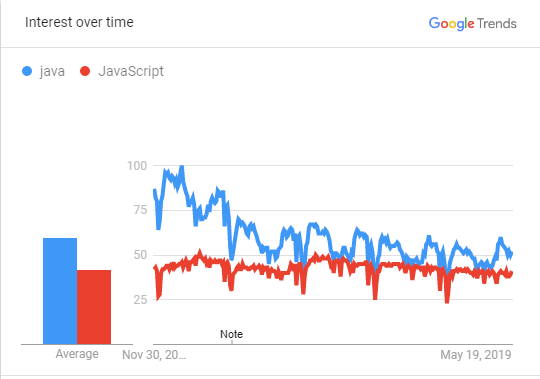
Google trends Java vs. Java script
Here are important features of Java-script:
- It’s a cross-platform language
- It’s widely used for client-side and server-side
- Strong Testing Workflow
- It’s easy to learn and to start coding with
- Added dependencies
Application of Java
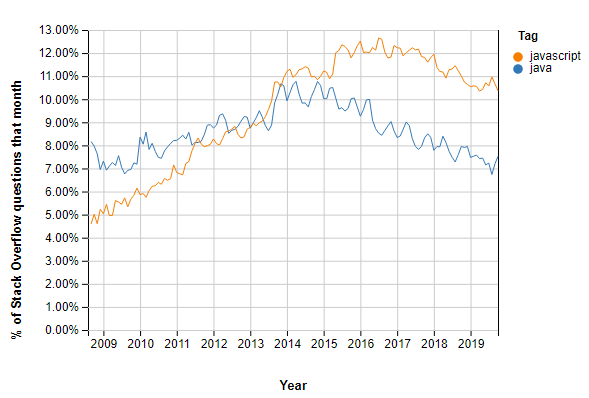
Stack Overflow Questions JAVA vs Java Script
Here, are important applications of Java language:
To develop:
- Android Apps
- Enterprise Software
- Scientific Computing Applications
- Big Data Analytics
- Java Programming of Hardware devices
- Used for Server-Side Technologies like Apache, JBoss, GlassFish, etc.
Application of JavaScript
Here, are some important applications of JavaScript:
- Dynamic Single-Page Applications (SPAs)
- Front-End technologies like jQuery, AngularJS, Ember.js, ReactJS are based on Java Script
- Server-Side technologies like Node.js, Express.js, MongoDB are based on Java Script.
- Mobile App Development using PhoneGap, React Native, etc.
Advantage of Java
Here, are benefits/ pros of using Java
- Detailed documentation is available.
- A large pool of skilled developers available
- Huge array of 3rd party libraries
- It allows you to form standard programs and reusable code.
- It is a multi-threaded environment that allows you to perform many tasks at the same time in a program.
- Excellent performance
- Easy to navigate libraries
Advantages of JavaScript
Here, are pros/benefits of using JavaScript
- It is an open-source project with Microsoft’s patronage
- Specially designed tool for small scripts
- Supports classes, interfaces, & modules.
- Compiled JavaScript runs in any browser
- Allows cross-compilation
- You can extend JavaScript for writing large apps
- You can use JavaScript to store and retrieve information on the user’s computer
- Immediate feedback to the visitors
- It allows you to create interfaces that react when the user hovers using mouse.
Disadvantages of Java
Here, are cons/drawback of using Java language
- JIT compiler makes the program comparatively slow.
- Java has high memory and processing requirements. Therefore, hardware cost increases.
- It does not provide support for low-level programming constructs like pointers.
- You don’t have any control over garbage collection as Java does not offer functions like delete(), free().
Disadvantages of JavaScript
Here, are drawbacks/cons of using JavaScript
- Client-side JavaScript does not allow the reading or writing of files. It has been kept for security reasons.
- JavaScript can’t be used for networking applications because there is not much support available.
- JavaScript doesn’t have any multithreading or multiprocessor features.
My Latest Posts
• • •
• • •
 GGI Coding Verse {Old}